

If you have a job that requires you to be constantly on your feet, are an avid runner who logs long distances regularly, or are often walking, running or standing, there’s a simple way to make your shoes more comfortable and supportive: add insoles to your running or walking sneakers.
Insoles are inserts you can put inside the base of your shoes to increase cushioning, boost arch support and improve fit. But putting the wrong ones in your sneakers can cause discomfort and pain. To help you shop for insoles that work for your feet, I asked podiatrists what to look for and compiled a list of recommendations that align with their guidance
The best insoles of 2026
The over-the-counter insoles below were selected with our experts’ criteria in mind.

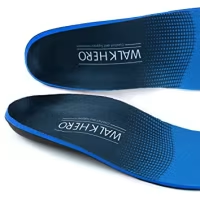
These insoles have a neutral arch (meaning they are medium height), making them suitable for most foot types. They are available in men’s sizes 7-14 and can be trimmed to fit your shoes better. They have gel pads in the heel cup and the forefoot to provide shock absorption and are lightweight, so they won’t add weight to your running sneakers.

These insoles have high-density foam in the heel to take some pressure off your arch as you walk. The insoles are available in women’s sizes 6-14.5 and men’s sizes 4-16.5. They are specially made to help those with plantar fasciitis, a common condition that involves inflammation in the tissue that runs down the center of the foot. They have a deep heel cup and a rigid bottom for support.

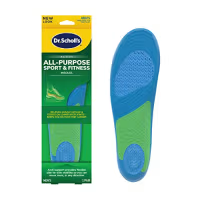
Though these insoles are intended to be used during athletic activities (such as running or at the gym), they can be worn anytime you need extra padding and arch support. They come in men’s sizes 8-14. Rather than trying to get your perfect size, the package comes with a guide that helps you trim them down to the right size for your shoes.
The insoles are made with special gel technology that the brand says gently massages your feet as you walk to add comfort. They have a low arch support and a deep heel cup for stability.

We can help you find

Dr. Bruce Pinker, a board-certified podiatrist and foot surgeon in New York, says these insoles (also available in men’s sizes) provide a nice amount of cushioning and support for an over-the-counter option. They are also available in women’s sizes 4-13 and are covered in moisture-wicking fibers to keep feet dry.
According to the brand, the center of the insole has extra cushioning to absorb shock as you walk, a built-in arch provides support, and the heel cup keeps your foot in place as you walk.

Unlike the other insoles on this list, these don’t run the full length of your foot. Instead, they go from the start of your arch to your heel. They are intended for those who struggle with plantar fasciitis; the deep heel cup is cushioned to provide relief from the tightness caused by the foot ailment, and they have a built-in arch for support. These insoles will fit men who wear sizes 8-13.

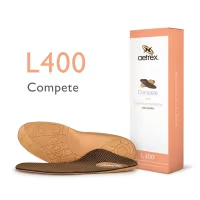
Available in women’s sizes 6.5-12, these insoles have a medium-high arch support and offer moderate cushioning, according to the brand. The sculpted heel cup absorbs impact as you step, and a moisture-wicking top cover prevents odors from sweat. These insoles have rigid bottoms, and are approved by the American Podiatric Medical Association. They’re also available in a version for men.

These insoles are intended for those who deal with plantar fasciitis or heel pain. They provide moderate cushioning and have a deep heel cut to support your foot as you step, according to the brand. They are available in different sizes, so you don’t have to trim them like some others on this list.

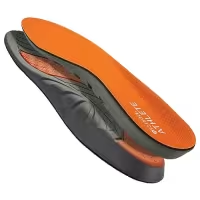
Made specifically for running, these insoles absorb shock, are flexible and come in three different arch support options — low, medium and high. They have a zero heel drop, so they fit inside most running shoes and have a mesh layer for breathability, according to the brand.
How I picked the best insoles
With so many over-the-counter insoles on the market, knowing what to look for when shopping is helpful. According to the podiatrists we spoke with, these are the key elements you should look for in an insole:
- Heel cup: Look for a sculpted heel cup, says Pinker. This will ensure your foot is cradled in a supportive way. The heel cup should wrap around the back of your foot without rubbing or irritating it as you walk.
- Cushioning: One of the biggest benefits of using an insole is that it can provide extra padding to your running or walking sneakers. With this in mind, look for insoles that have adequate cushioning for your needs, says Pinker. The insoles should have a layer of foam or gel for some softness as you step.
- Rigidity: In addition to cushioning, insoles can provide support. Look for cushioned but semi-rigid insoles — if they are flexible, they won’t have proper support, says Dr. Mohammad Rimawi, a board-certified podiatrist in New York City. If you have flat feet, you can also look for arch support insoles.
What are the benefits of insoles?
Insoles serve different purposes for different people, “but their main function is the ability to provide the feet with support,” says Rimawi. They can be particularly good for those with flat feet or high arches. “When one suffers from flat feet or too high of an arch, this can distribute weight on the foot in a manner that may leave them more prone to injury and pain,” says Rimawi. “The job of insoles is to provide support and redistribute that weight in a more stable manner.”
Even if you don’t have arch issues, insoles can provide more comfort as you walk. “They provide cushioning and support as it offloads pressure points on the foot,” says Pinker. “They can also improve the biomechanics of one’s feet and reduce pain in the feet.” Because of the extra cushioning, they can also be good for those dealing with plantar fasciitis, a condition where your plantar fascia (a thick band of tissue that runs down the length of your foot) gets inflamed. This can happen from working out in shoes with no support, tight calves, carrying excess weight and more.
There are many different types of insoles available. They are made from plastic or foam and placed inside your shoes. Over-the-counter insoles provide more generic support and padding. Or, you can have custom insoles made at your podiatrist’s office. “Each person’s foot is unique, and over-the-counter insoles are inherently generic,” says Rimawi. Therefore, you may find that the insoles provide too much support, causing pain, or, inversely, too little support, which doesn’t alleviate symptoms. Custom insoles can help you avoid this.”
While custom insoles (also called orthotics) can provide personalized support, over-the-counter insoles can also help. “They can provide cushioning and shock absorption and possibly reduce pain in the heel or arch,” says Pinker. “They aren’t harmful, though they may not be helpful to those with serious foot conditions.”
How do you know if you need insoles?
“Insoles really do provide support, comfort, shock absorption and protection,” says Rimawi. “Therefore, anyone can benefit from wearing them.” That said, some people benefit from them even more than others. You may benefit from insoles more than most if you have flat feet. “When one has a flat foot, the forces placed on the foot are severely skewed and can lead to pain or injury,” says Rimawi. “Insoles with proper arch support can mitigate this.”
“Insoles can also be particularly good for those who deal with pain in the heel or ball of the foot,” says Pinker. This is because insoles can help redistribute your weight so it is not all being placed on whichever area is uncomfortable.
Another important thing to know: “Over-the-counter insoles work best in sneakers,” says Rimawi. “Custom insoles, however, can be made to fit in dress shoes, boots and sneakers.”
Meet our podiatrists
At NBC Selected, we work with experts with specialized knowledge and authority based on relevant training and/or experience. We also ensure all expert advice and recommendations are made independently and without undisclosed financial conflicts of interest.
- Dr. Mohammad Rimawi is a board-certified podiatrist in New York City.
- Dr. Bruce Pinker is a board-certified podiatrist and foot surgeon in New York.
Why trust NBC Selected?
I am a commerce editor at NBC Selected and a journalist who regularly covers health and wellness, among other topics. I have recently written stories on the best snow boots with arch support and the best steel-toe boots. For this story, I spoke with podiatrists about shopping for the best insoles for your feet.
Catch up on NBC Selected’s in-depth coverage of tech and tools, wellness and more, and follow us on Facebook, Instagram, X and TikTok to stay up to date.