Image: Cherry Springs State Park, Pa.
David Wymer  /  Visit Pennsylvania
Cherry Springs State Park, Pa., is a 48-acre park heralded by stargazers as one of the best locations to see a pristine night sky, which includes a view of the Milky Way Galaxy's nucleus.
By
updated 6/24/2008 3:37:40 PM ET 2008-06-24T19:37:40

The night sky is disappearing before our eyes. The thousands of stars once visible to the naked eye are now obscured by the glare of industrial light and the haze of pollution. This is particularly true in the U.S. and Europe, where light researchers estimate that a child born today in either region has a one in 10 chance of witnessing a truly dark sky.

Though most people will insist they have seen this dazzling spectacle, dark skies as nature intended them are rare. City dwellers, for example, usually glimpse fewer than 500 stars. In the most undisturbed areas, some 15,000 stars are on display as is the sprawling Milky Way. Stargazers under this kind of night sky might see 30 or more meteors per hour.

"You can no longer just take a short drive from the city and look at the Milky Way or the northern lights," says Chad Moore, a board director for the International Dark-Sky Association, a Tucson-based nonprofit organization. "Now it's quite an endeavor to find those dark places."

Luckily, budding stargazers will find that summer is the ideal season to start looking. While cool winter skies are less obscured by haze and humidity, temperatures can be prohibitively cold. Since the best night skies are in very remote locations where lodging options are limited to small inns or outdoors camping, potential stargazers should get used to the idea of roughing it. The pay-off will be more than memorable, however, when you return with memories of a galaxy rarely seen.

Setting the standard
Pristine night skies are an endangered habitat, at least according to the International Dark-Sky Association. They are not only beautiful to behold, but they are an integral part of wild and human life.

Light pollution, defined as obtrusive light that affects the environment, can disrupt the circadian rhythm of humans and the patterns of nocturnal animals. For humans, chronic light pollution can inhibit the production of the restorative hormone melatonin. Artificial light can also trick nocturnal animals into sleeping or migrating at the wrong time.

As industrial light creeps as far as 200 miles from its origin, threatening formerly remote skies, the IDA has started designating certain areas as refuges. These are skies so dark "that it becomes difficult to pick out the constellations." says Moore. "You might spend 30 minutes dark-adapting, but afterward you can still walk around and not trip on things."

The first park to receive the designation of "International Dark Sky Park" was Utah's Natural Bridges National Monument. In the southeastern corner of the state, this park boasts Bortle Class 2 skies. The Bortle Dark-Sky Scale measures night sky brightness on a scale of one to nine, or pristinely dark to inner-city bright.

In layman's terms, this means that stargazers at National Bridges can see the marbled structure of the Milky Way and the whitish glow of the zodiacal light, a faint band of particles that runs east to west. During the summer, rangers lead educational walks and programs to teach visitors about astronomy.

The IDA has deemed only one other U.S. park as an International Dark Sky Park. Cherry Springs State Park on Pennsylvania's northwestern border is 48 acres of unspoiled stargazing, which includes a view of the Milky Way Galaxy's nucleus. What you won't see is frequent air traffic, overhead electrical lines or obtrusive park lighting.

Starry, starry skies
These two parks have set the standard for stargazing, but there are several locations around the world that offer equally stunning views.

Mont-Mégantic National Park in Quebec, Canada, sits within a newly designated International Dark Sky Reserve, a patchwork of land in Canada dedicated to preserving excellent night sky conditions. It is notable not only for its unobstructed view of the skies, but also for its ASTROLab, an astronomy interpretation center open to the public.
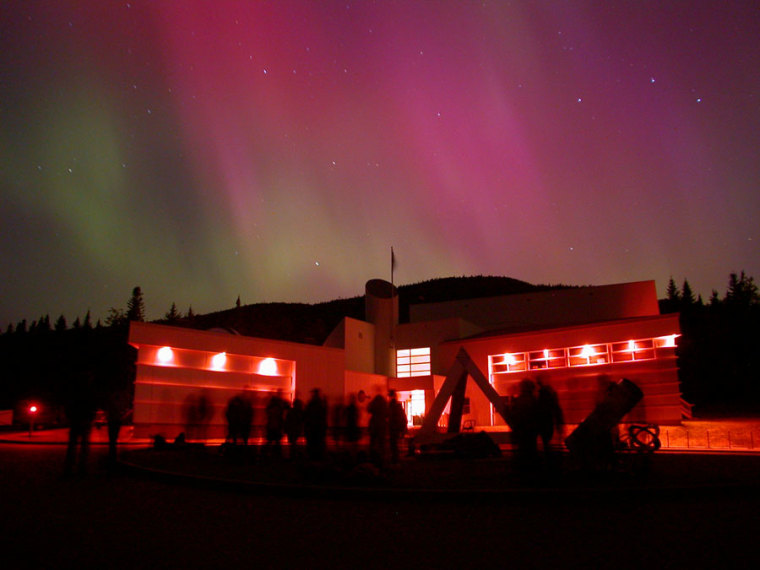
Image: Mont-Mégantic National Park, Quebec, Canada
Sebastien Giguere  /  Parc national du Mont-Mégantic
The Mont-Mégantic National Park, Quebec, Canada sits within a newly designated International Dark Sky Reserve, a patchwork of land in Canada dedicated to preserving excellent night sky conditions. Mont-Mégantic is notable not only for its unobstructed view of the skies, but also for its ASTROLab, an astronomy interpretation center open to the public. It is located about 145 miles east of Montreal.
Among the eucalyptus woodlands in New South Wales, Australia, there is 100 acres of land designated for stargazing. Owned by a local astronomy society, the land has both observation facilities and basic accommodations, though most prefer to camp. Each year, the society hosts a "South Pacific Star Party," during which 200 to 400 people convene for a weekend of star watching beneath one of the world's darkest skies.

Parties like these are organized frequently around the world, and are a great opportunity for novice stargazers to learn more about the hobby. Another occasion is a night sky event like the Perseid meteor showers this August. For a few hours between early morning and early dawn on Aug. 12, 50 to 100 shooting stars will pass through the sky.

"These meteors are all different brightness," Joe Rao, an associate/guest lecturer at the Hayden Planetarium at the American Museum of Natural History. "Some streak across the skies, explode right in front of you and pop like a flashbulb."

To truly enjoy the show, he says, bring company. "It's a lot of fun when you're with other people," he says. "If you see a big one, you'll hear a roar like someone just hit a home run."

© 2012 Forbes.com

Photos: Month in Space: April 2013

loading photos...
  1. The view from space

    This view from the International Space Station shows the sun heading toward the horizon over southwestern Australia on April 2, 2013. The space station's solar panels loom in the foreground. (Commander Chris Hadfield / CSA via AFP - Getty Images) Back to slideshow navigation
  2. Horsehead of a different color

    The Horsehead Nebula takes on an eerie glow in an infrared image from the Hubble Space Telescope. This picture, released April 21, marks the 23rd anniversary of the famous observatory's launch in 1990 aboard the space shuttle Discovery. (NASA / ESA / Hubble Heritage Team via EPA) Back to slideshow navigation
  3. Tight quarters

    Italian astronaut Luca Parmitano (right), NASA astronaut Karen Nyberg (left) and Russian cosmonaut Fyodor Yurchikhin get their picture taken inside a Soyuz capsule simulator during a training exercise at Russia's Star City complex outside Moscow on April 26. The three spacefliers are scheduled to head for the International Space Station in May. (Sergei Remezov / Reuters) Back to slideshow navigation
  4. Blazing sun

    This full-disk view of the sun was captured by NASA's Solar Dynamics Observatory on April 11, during the strongest solar flare yet seen in 2013. The colors reflect the intensity of emissions in extreme ultraviolet wavelengths. (NASA / SDO) Back to slideshow navigation
  5. Evil eye

    Mountain ridges near San Alberto in Mexico look like a reptilian eye in this view from the International Space Station. Canadian astronaut Chris Hadfield uses a different metaphor: "A Dali watch on an alligator wristband." The picture was taken on April 15 and shared via social media on April 25. (Commander Chris Hadfield / Canadian Space Agency) Back to slideshow navigation
  6. Russian rocket's red glare

    A Russian Soyuz rocket blasts away from its launch pad at the Baikonur Cosmodrome in Kazakhstan on March 29, sending NASA astronaut Chris Cassidy and Russian crewmates Pavel Vinogradov and Alexander Misurkin toward the International Space Station for their six-month orbital tour of duty. (Sergei Ilnitsky / EPA) Back to slideshow navigation
  7. Fun with rockets

    Children hold self-made rocket models during a show in front of the Peter and Paul Fortress in St. Petersburg, Russia, on April 14. The gathering was part of the festivities surrounding Cosmonautics Day on April 12. The Russian holiday marks the anniversary of Soviet cosmonaut Yuri Gagarin's historic spaceflight in 1961 - an occasion marked in other countries as "Yuri's Night." (Alexander Demianchuk / Reuters) Back to slideshow navigation
  8. Strokes in the Sahara

    Geological formations take on an alien look in a picture of the southern Sahara in Mauritania, taken on March 19 from the International Space Station and shared via social media on April 24. Canadian astronaut Chris Hadfield calls the scene "effortless natural art." (Commander Chris Hadfield / Canadian Space Agency) Back to slideshow navigation
  9. Stars in the cloud

    This glittering picture shows X-ray emissions from young sunlike stars in the "wing" of the Small Magellanic Cloud, a satellite galaxy associated with the larger Milky Way. The Small Magellanic Cloud lies about 180,000 light-years from Earth. In this April 4 picture, readings from the Chandra X-ray Observatory are shown in purple; visible light seen by the Hubble Space Telescope is in red, green, and blue; and infrared readings from the Spitzer Space Telescope are indicated in red. (NASA via Reuters) Back to slideshow navigation
  10. A blast on Mars

    This image from the high-resolution camera on NASA's Mars Reconnaissance Orbiter shows a relatively youthful crater with dark-rayed ejecta, plus a light-toned zone that extends beyond that ejecta. The picture was taken in 2009, but it was released along with other images from the High Resolution Imaging Science Experiment, or HiRISE, on April 3, 2013. Watch a video about the crater (NASA/JPL/University Of Arizona) Back to slideshow navigation
  11. A new rocket rises

    Orbital Sciences Corp.'s Antares rocket rises for the first time from its launch pad on April 21 at the Mid-Atlantic Regional Spaceport on Wallops Island, Va. This practice launch was aimed at testing the rocket for what's expected to be regular cargo deliveries to the International Space Station (Terry Zaperach / NASA Wallops via AP) Back to slideshow navigation
  12. Storm over the Middle East

    An image from NASA's Terra satellite shows a thick plume of dust blowing over the eastern Mediterranean Sea on April 1. The clouds spread over Israel, the West Bank, Cyprus and Turkey in a giant, counterclockwise arc. (NASA via AFP - Getty Images) Back to slideshow navigation
  13. Blue heaven

    A March 27 photo from the European Southern Observatory shows the bright open star cluster NGC 2547, as seen by the Wide Field Imager on the MPG/ESO 2.2-meter telescope at the La Silla Observatory in Chile. Many remote galaxies can be seen between the bright stars, far away in the background of the image. (ESO via AFP - Getty Images) Back to slideshow navigation
  14. Ready for a rocket ride

    Launch crew members check NASA astronaut Chris Cassidy's spacesuit just before his March 28 launch to the International Space Station. Russian cosmonauts Pavel Vinogradov and Alexander Misurkin joined Cassidy in a Soyuz capsule for a quick six-hour ride to the station. (Ramil Sitdikov / Ria Novosti / EPA) Back to slideshow navigation
  15. A supersonic leap

    Virgin Galactic's SpaceShipTwo lights up its rockets for the first time in flight on April 29. Afterward, the company said in a tweet that the pilots confirmed "SpaceShipTwo exceeded the speed of sound on today's flight!" The reported maximum velocity was Mach 1.2. Virgin Galactic plans to send paying passengers on suborbital space trips on a regular basis. (MarsScientific.com / Clay Center Observatory via EPA) Back to slideshow navigation
  16. Where stars are born

    An enormous stellar nursery known as W3 shines in infrared light, as shown in a March 27 image from the European Space Agency's Herschel space observatory. W3 lies about 6,200 light-years away in the Perseus Arm, one of the Milky Way galaxy's main spiral arms. In this image, low-mass stars are seen as tiny yellow dots embedded in cool red filaments. In contrast, high-mass stars emit intense radiation that heats up the gas and dust around them. Those hot regions are shown here in blue. (ESA via AFP - Getty Images) Back to slideshow navigation
  17. Crazy quilt

    The rugged landscape of Iytwelepenty/Davenport Murchison National Park in the Australian Outback is "crazily beautiful" when seen from outer space, Canadian astronaut Chris Hadfield says. Hadfield sent down this picture from the International Space Station on April 21. (Commander Chris Hadfield / Canadian Space Agency) Back to slideshow navigation
  18. A comet's glow

    Comet ISON takes on a fuzzy glow in an April 10 image from the Hubble Space Telescope. This picture was taken when the comet was 394 million miles from Earth, but Comet ISON is expected to get much closer. Some skywatchers hope it will become bright enough to rank as the "Comet of the Century." (J.-Y. Li (PSI) / NASA / ESA) Back to slideshow navigation
  1. Editor's note:
    This image contains graphic content that some viewers may find disturbing.

    Click to view the image, or use the buttons above to navigate away.

  2. Editor's note:
    This image contains graphic content that some viewers may find disturbing.

    Click to view the image, or use the buttons above to navigate away.

  3. Editor's note:
    This image contains graphic content that some viewers may find disturbing.

    Click to view the image, or use the buttons above to navigate away.

  4. Editor's note:
    This image contains graphic content that some viewers may find disturbing.

    Click to view the image, or use the buttons above to navigate away.

Discuss:

Discussion comments

,

Most active discussions

  1. votes comments
  2. votes comments
  3. votes comments
  4. votes comments
  1. Image: Cherry Springs State Park, Pa.
    David Wymer / Visit Pennsylvania
    Jump to text

    The night sky is disappearing before our eyes. T...

  2. Image: US-SPACE-ISS-AUSTRALIA
    Commander Chris Hadfield / CSA via AFP - Getty Images
    Jump to photos

    Month in Space: April 2013

  3. Jump to discussion

    World’s best places to see the stars