

Your window air conditioner isn’t exactly the prettiest decor, but it is one of the best tools for staying cool in warm weather, especially if (like me) you don’t have central air.
Window ACs are more powerful and energy efficient than portable ACs, and take up less floor space too. So I spoke with appliance and energy experts to better understand what to look for in an AC unit, and to recommend the best ones for you.
 For air quality detection$429.00$460.00


Related

Want more from NBC Select? Sign up for our newsletter, The Selection, and shop smarter.
The best window ACs in 2026
Our top picks come from a mix of large appliance companies like LG and newer brands like Windmill Air. I highlighted important details like cooling power, recommended room size and dimensions inside the “What to know” menu.
Best overall


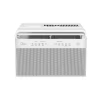
This Midea U AC is everything I want out of an air conditioner — I love it so much I bought two (and influenced fellow NBC Select reporter Zoe Malin to buy one). It’s a u-shaped AC where your window slots in between the two halves of the unit — you can still open and close your window even after the AC is installed. I’ve had them for more than three years and my units have stayed quiet, effective and easy to use.
I love that I can control it with the physical buttons on the unit, the included remote or, if I connect it to Wi-Fi, the Midea SmartHome app, Amazon Alexa and Google Home voice assistants.
Runner-up

Let’s face it: Most air conditioners are kind of ugly. This model from Windmill is one of the most aesthetically pleasing, which is part of the reason NBC Select editorial direction Lauren Swanson has hers. It’s clean and minimal, and was very easy to set up, though we’d recommend an extra set of hands to actually lift it into the window — it weighs 61 pounds.
Like the Midea U, you can control this AC with the on-unit buttons, included remote control or Windmill mobile app. NBC Select senior editor Nikki Brown prefers the mobile app, which comes in handy while traveling.
For small rooms

Malin used this air conditioner for small rooms in her 200-square-foot kitchen for years (before replacing it with a Midea U). It’s smaller and less powerful than our top picks, but it’s also significantly less expensive. It has controls on the unit and comes with a remote, but it does not have a mobile app. It’s also noisier than the Midea U and Windmill ACs. Malin never minded the noise, but if you’re looking for tranquility in your home, consider another one of our top picks.
For air quality detection

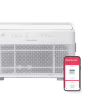
Before I bought Midea U ACs, I used a Frigidaire Gallery AC for years. This newer model is even more powerful and energy efficient than the one I used years ago, and can cool just as effectively as the Midea U and Windmill ACs. One way it stands out is that it can also detect and monitor the indoor air quality in your space, and give you alerts through the Frigidaire app.
You can also pair this AC with Frigidaire PureAir air filters, which adds some air purifier ability to your unit. Not as much as a dedicated air purifier, but still useful.
Most affordable

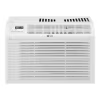
If cost is your first priority, this top-rated window air conditioner from Midea is the lowest priced on our list. It is rated to cool a room size up to 150 square feet — think bedrooms or home offices. You control the AC via the dials on the unit — it does not come with a remote or smart app like our other recommendations. Note that this is the loudest AC on our list, so anyone sensitive to noise may want to spend a little more on a quieter unit like the Midea U.
A portable air conditioner

This Black+Decker portable air conditioner for small rooms cools spaces up to 350 square feet — think bedrooms and offices. While there are a few size options available, this 8,500 BTU version is one of the most compact and best priced. It has built-in wheels on each corner that make it easy to move from room to room.
Related

How I picked the best window air conditioners
To understand the technical elements of air conditioning, and how best to compare different models, I spoke with experts. Using their expertise as guidance, I selected air conditioners with the following criteria in mind:
BTU (British Thermal Units): British Thermal Units (BTU) are a measurement of the amount of power an air conditioner uses to cool a space. The higher the BTU, the more efficiently it will be able to cool a space of different sizes. For example, an air conditioner with a BTU of 5,000 is best suited for a small room, while a BTU of 8,000 or more may be suited for a small home.
Room size: I picked air conditioners fit for different room sizes ranging from 150 to 450 square feet. AC manufacturers often advertise recommended room size for their units, which makes it easier to choose an appropriate size.
Extra features: Window air conditioners can come with extra features like automatic cooling modes, a remote control and smart app connectivity. I made note of all of these features in each product recommendation.
How to shop for a window air conditioner
Window ACs are the most popular kind of air conditioner among NBC Select staffers, and are “best when cooling a single area like a bedroom or large living space,” says Brice Bowley, senior director of air conditioner technology at GE Appliances.
For larger homes with multiple rooms or floors, “it may be cheaper and more energy efficient to choose a central or multi-split cooling system like central air conditioning or a heat pump,” says Leslie Jones, the senior media and public affairs specialist for Energy Star labeled products at the U.S. Environmental Protection Agency (EPA).
Regardless of your space, there are a few key terms and labels to understand in order to purchase the best, most efficient air conditioner possible, according to our experts.
BTUs (British Thermal Units)
As I mentioned previously, air conditioner’s cooling power is measured in BTUs, or British Thermal Units. The higher a unit’s BTU rating, the larger a space it can cool. Below is a breakdown of the number of BTUs needed to cool different-sized spaces, according to Jones and Energy Star:
- Up to 250 square feet: 5,000 to 6,000 BTUs
- From 250 up to 350 square feet: 7,000 to 8,000 BTUs
- From 350 up to 450 square feet: 9,000 to 10,000 BTUs
- From 450 up to 550 square feet: 12,000 BTUs
- From 550 up to 700 square feet: 14,000 BTUs
Your room’s square footage isn’t the only number to think about when assessing how powerful an AC unit you’ll need, according to Energy Star. If your space is heavily shaded, you need 10 percent less BTUs. A very sunny room, meanwhile, needs 10 percent more BTUs. Any AC unit used in a kitchen should have an extra 4,000 BTUs to counteract heat-generating appliances.
CEER (Combined Energy Efficiency Ratio)
CEER stands for combined energy efficiency ratio. In simple terms, it is one popular way to measure how efficient an air conditioning unit is. A unit with a higher CEER is more energy efficient than a unit with a lower CEER.
For window ACs, you’ll typically see a CEER between 11 and 15. Since 2014, all window units with a BTU rating under 8,000 must operate at a minimum CEER of 11, following standards put in place by the U.S. Department of Energy (DOE). This standard is currently being updated: By May 2026, the minimum CEER for similar products will be 12.8. For window units with a BTU rating above 8,000, the DOE is pushing for an even higher CEER, and encouraging manufacturers to use inverter technology to increase CEER scores.
Portable AC units are less energy efficient, so it’s more common to see CEER scores ranging from five to nine.
Look for an AC that uses inverter technology
Most older or smaller ACs are non-inverter units. Non-inverter units use a simple compressor that is either 100 percent on, trying to cool your space to the temperature you set, or 100 percent off, having reached the desired temperature.
Inverter ACs have a variable speed compressor to more efficiently maintain the temperature you set. Instead of running at full-blast or completely turning off, an inverter AC will run faster or slower depending on the needs of the space, similar to a car using cruise control to maintain a certain speed, says Jones.
Inverter ACs tend to be more energy efficient and have a higher CEER than non-inverter ACs, but they are more expensive. The money you save on your energy bill can offset the initial purchase cost in the long run, though.
Look for an Energy Star certified AC
Energy Star is a program within the EPA and DOE that promotes energy efficiency in a broad range of appliances. Products that earn an Energy Star symbol are “independently certified to help consumers to save energy and money while protecting the environment,” says Jones.
For a window AC unit to meet Energy Star certified requirements, “it must be at least 10 percent more efficient than the federal minimum for this product type, and meet other requirements outlined in the most recent Energy Star product specification,” says Jones.
You can verify if a product is Energy Star certified through Energy Star’s online product finder tool.
Frequently asked questions
The air quality outside can shift dramatically during certain weather patterns or natural disasters like wildfires. Poor air quality can cause irritation, trigger allergic reactions and lead to long-term health problems, according to the EPA.
Certain types of air conditioners should not be used if there is heavy smoke outside. If you have a window unit, you can still use it if the air damper is closed. Just make sure the seal between the air conditioner and the window is as airtight as possible, says Jones.
Do not use single hose portable air conditioners if there is heavy smoke outside, as these will potentially bring smoke into your space. Dual hose portable air conditioners can be used, but monitor them carefully and make sure the seal between the window vent kit and window is airtight, says Jones.
Meet our appliance experts
At NBC Select, we work with experts who have specialized knowledge and authority based on relevant training and/or experience. We also take steps to ensure all expert advice and recommendations are made independently and without undisclosed financial conflicts of interest.
- Brice Bowley is the senior director of air conditioner technology at GE Appliances. (Since GE Appliances sells air conditioners, I only spoke with Bowley about HVAC guidance, and did not ask for specific product recommendations.)
- Leslie Jones is the senior media and public affairs specialist for Energy Star labeled products at the U.S. Environmental Protection Agency (EPA).
Why trust NBC Select?
I’m a reporter at NBC Select who covers technology, fitness and outdoors, including stories on fitness trackers, wireless earbuds and camping for beginners. I’ve been writing about HVAC systems and air purifiers for years, and interviewed filtration and appliance experts to better understand how portable air conditioners work. I also spoke with NBC Select staffers about their experience using different air conditioners in their home.
Catch up on NBC Select’s in-depth coverage of tech and tools, wellness and more, and follow us on Facebook, Instagram, Twitter and TikTok to stay up to date.


