

If you find yourself in the position of having to care for elderly parents, you are not alone. In fact, according to the Population Reference Bureau, as of 2022, 24 million adults in the United States care for an older family member. And while taking care of a loved one can be incredibly gratifying, it can also be stressful. One thing that can help is having the right tools to make caretaking easier. That includes things like pill cases, certain types of blankets and even smart home hubs that make both an aging parent’s life easier, as well as your own.
“When taking care of an elderly parent at home there are many tools that can be helpful,” says Nina Dejewski, occupational therapist for United Disabilities Services Foundation. “Of course, what you need may vary based on the level of assistance the parent needs — and it can change over the course of taking care of them. The most important thing is to keep you, the caregiver, and the parents safe with all mobility and daily tasks.”
To help you determine what items may be useful in helping you take care of an aging parent, I interviewed medical professionals and caretakers. Below, they share what to consider when shopping for items that can help you take care of aging parents, as well as recommendations for specific types of products.


 Best medical alert device$37.79$41.99


How I picked the best essentials for when you’re caring for an aging parent
Your parent’s specific condition will determine what will be most helpful when it comes to taking care of them — and their medical providers should be able to help you come up with a list of items that you may need. That said, experts I spoke to did say there are general guidelines that can help you figure out what may be useful.
“Think through the ‘five Ms’ of geriatrics — which focus on what truly supports health, safety and quality of life for older adults,” says Dr. Kara Watthanasuntorn, geriatrician and medical director at Center for Better Aging. Below, Watthanasuntorn shares what those “five Ms” are and what type of supplies would fall under them.
- Medication organization and reminders: This is critical, especially for older adults who take multiple prescriptions, says Watthanasuntorn. Pill organizers, pill packs or locked dispensers can reduce missed or double doses and medication reminders such as alarms or apps can help with consistency.
- Mobility aids: Fall prevention should be a top priority, so items like non-slip bath mats, grab bars, handrails on stairs and clear walking paths can reduce risk.
- Memory tools: If you have a parent dealing with memory issues, simple orientation tools like large clocks and calendars help them stay grounded in time and routine, says Watthanasuntorn. These tools are helpful even for people without diagnosed memory issues.
- Multiple chronic conditions: Think about tools that can match a person’s specific health needs — like a blood pressure cuff to monitor high blood pressure, pulse oximeters for lung disease and glucose monitors for diabetes. Often, an elderly parent will have multiple things going on and you’ll need a few of these types of items.
- Medical alert devices: For those at risk for falls, medical alert devices can provide safety and independence.
Related

Want more from NBC Select? Sign up for our newsletter, The Selection, and shop smarter.
The best products for taking care of aging parents
Based on the “five Ms” above, I sourced highly-rated items that can be helpful to have when taking care of an elderly parent. All of the items either have features that an expert highly recommended to me or have at least a four-star average rating from hundreds of reviews.
The best medication organizers and alarms for aging parents

“It is essential to organize medications and help with compliance,” says Arita McCoy, a specialist in geriatric medicine who works with the MedStar Health Center for Successful Aging. This pill case has two removable trays — one for the morning and another for the evening. Each has seven compartments labeled with each day of the week in large letters. One tray has suns to denote that it is for morning, while the other has moons for evening medications. The compartments have push buttons, which are easier for arthritic hands to open and they can fit up to 60 aspirin, according to the brand.

You can program this alarm clock to remind an aging parent when it’s time to take medication — a voice will come on at the set time to say something along the lines of, “Good morning, please take your morning pills.” You have the ability to set up to four alarms daily and there are loud and extra-loud settings for parents with diminished hearing. The clock runs on two AA batteries and has large, easy-to-read buttons.

If you (or your loved one) is constantly trying to remember if meds were taken, consider this visual reminder. It can be placed on a counter near where you keep medication or you can stick it to the front of your fridge using the included magnets. Once meds are taken, you simply toggle the button so you don’t forget later.
The best mobility aids for aging parents

The simple act of getting up and down gets harder as you age, so having a railing attached to the side of the bed can assist with mobility, says occupational therapist Dejewski. To install this rail, all you have to do is slide it between the mattress and box spring. The handle is non-slip to give traction as it is grabbed and there is also a motion sensor light on the side that will illuminate a dark room if it is activated in the middle of the night.

Dejewski says that a shower chair can be helpful for aging parents who may not have the stamina to stand for long periods of time or aren't nimble enough to safely lower themselves into a tub. This one holds up to 500 pounds and has skid-resistant feet to keep it firmly in place. It also has padded armrests that your loved one can use to brace themselves as they sit or stand.

Similar to getting into the shower, maneuvering up and down from the toilet can get more challenging as you age. “Installing grab bars or a toilet safety frame allows for increased ease and safety with toilet transfers,” says Dejewski. This one has a maximum weight of 300 pounds and can be installed on most toilets, according to the brand. You can adjust its height and the hand rails have grips for added stability.
The best memory tools for aging parents

If your parent is dealing with memory issues — whether it be from basic aging or something like dementia — reminders of simple things like date and time can help, says Watthanasuntorn. This digital clock is available in three sizes (8-, 12- and 15-inches) and it lists the numerical date, time, day of the week and whether it is morning, afternoon or evening. You can also set up to five alarms per day for things like medication reminders or appointments.

If a cell phone is too complicated, consider getting your aging parent a landline designed for elderly people. This one has large numbers that are easy to read, along with nine customizable buttons at the top that you can program to call specific people or places. You can then label those buttons with photos so they’re easily identifiable.
The best tools for aging parents with multiple chronic conditions

A pulse oximeter can help measure blood oxygen saturation, helping you to make sure your aging parent is getting enough oxygen. This device runs on two AAA batteries and can fit fingers of all sizes. It has a large LED display and also reads heart rate.

I had to monitor my blood pressure during my pregnancy and found this at-home option to be easy to use. It goes on your wrist and you just push a button to get it started. It comes with a charger and has a voice broadcast setting that will read your results to you, making it a nice option for elderly individuals with poor eyesight.

A heated blanket can be soothing and help with a number of issues older people tend to face — like temperature regulation, muscle strain and arthritis pain, says Medstar Health’s McCoy. This one comes with a remote that has four time settings and has a three-hour auto shut-off to prevent overheating. The blanket is also machine-washable, according to the brand.
The best medical alert devices for aging parents

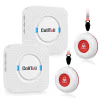
This set comes with two receivers and two call buttons. The call buttons can be worn as a necklace and, when pressed, will send an alert to the receiver if it is within 500 feet. This can be a good system to use if you live in a multi-level home with an elderly parent and want to make sure they can let you know if they’ve fallen or are struggling.

If you don’t live in the same home as your aging parent, you may want a medical alert device that can call outside the home. This lightweight handheld device is water-resistant, rechargeable and with just the press of a button can call a family member, friend or 911 (depending on how you program it). The device allows for two-way communication once the button is pressed.

“Video monitors can be used to assist with supervision and safety,” says Dejewski. This camera from Blink provides 360-degree coverage that you can view from your smartphone, tablet, or compatible Alexa device. You can use the compatible app to tilt the camera in any direction and it has two-way voice capabilities, so you can talk to whoever is on camera and hear their response.


Though not technically a medical alert device, an AirTag can be helpful. It can be placed in a pocket, on keys or inside a wallet for those who may be at risk for wandering, says McCoy. The AirTag is about the size of a quarter and it syncs to your iPhone so you can use the Apple FindMy app to pinpoint the exact location of your AirTag if it’s within 30 feet. When you’re near the tracker, you can use its Precision Finding feature, which guides you toward the AirTag using an arrow that points you in the right direction.
Frequently asked questions
Your parent’s medical providers will be the most helpful in guiding you when it comes to tools and items that may make caretaking easier. Beyond that, dedicate a bit of time to noticing where the biggest pain points are. For example, if they have a hard time remembering to take medication, you may want to invest in a medication alarm. If you find that they’re constantly asking you the time, a large clock that they can clearly see can help. Much of what may help is dependent on your parent’s individual needs, says Dejewski.
Whether your parent has Medicare or private insurance, certain items — like a walker or other mobility aid — may be covered if a doctor has recommended or prescribed that item. If your parent has a flexible spending account (FSA), most of the items not covered by insurance can be purchased using those funds.
Meet our experts
At NBC Select, we work with experts who have specialized knowledge and authority based on relevant training and/or experience. We also take steps to ensure all expert advice and recommendations are made independently and without undisclosed financial conflicts of interest.
- Nina Dejewski is an occupational therapist at the United Disabilities Services Foundation.
- Dr. Kara Watthanasuntorn is a geriatrician and medical director at Center for Better Aging.
- Arita McCoy is a specialist in geriatric medicine who works with the MedStar Health Center for Successful Aging.
Why trust NBC Select?
I’m a commerce editor at NBC Select and a journalist who regularly covers beauty, home and lifestyle. I have recently reported on vibration plates and red light therapy for hair loss. For this story, I interviewed medical professionals who work with elderly patients and their families on what is helpful to have for caretaking.
Catch up on NBC Select’s in-depth coverage of tech and tools, wellness and more, and follow us on Facebook, Instagram, Twitter and TikTok to stay up to date.


