

If spiders give you the ick, it’s understandable that having them in your home is a major no-no. And if they really affect your nervous system, grabbing a jar (or shoe) to get them out is not as easy as it sounds.
“Action thresholds are really built on the level of comfort someone has,” says Walker Hale, an entomologist at Pest Share, a platform for finding pest control experts. “One spider to a person that is phobic, is one too many.”
One thing to know: Spiders are far less likely to come in droves than other pests like bed bugs, fruit flies and roaches. Meaning, if you see one, there really may just be one. That said, if you want to get rid of spiders you find in your home, there are a number of items that can help you evict those eight-legged critters. To find out which ones are the most effective, I spoke with pest control experts for their best advice.
 Best catch and release tool$11.99$14.00


The best spider traps of 2026

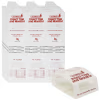
Glue traps can be an easy way to capture spiders that may be roaming around your home, says Scot Hodges, entomologist and vice president of professional development and technical services at Arrow Exterminators. These traps are a true multitasker and can be used to capture spiders, crickets, roaches and other insects that tend to crawl along the floor. You get 30 pesticide-free traps in this pack.
To use them, you tent the trap, creating a cave-like structure and remove the adhesive protector to reveal the glue. Then, when bugs crawl inside, they get stuck and you can pick up the trap and throw it away.

These traps are specifically made for brown recluse spiders, hobo and wolf spiders and black widows. Unlike traditional glue traps, these traps are ready to go right out of the box. Inside the structure are glue dots, which will catch spiders as they try to move through the tunnel-shaped trap. The brown plastic shell is discreet and can be tucked under your couch and other furniture to discretely trap spiders.

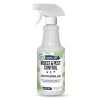
Essential oils like peppermint and citrus can repel spiders, says Hale. This spray contains peppermint to kill and deter spiders. Because it’s made from all natural ingredients, it is safe for homes that have kids, dogs and cats. It can be sprayed on spiders you find or spritzed around the perimeter of your room to discourage them from entering. According to the brand, the spray can be used on ants and roaches, too.

If you’re less concerned with going the natural route, grab this spray from Raid that can tackle spiders, ants, roaches, scorpions and more. It kills bugs on contact and can also be used as a preventative measure by spraying it around a room you’ve seen a spider in. The spray lasts up to seven weeks on porous surfaces and up to 12 weeks on non-porous surfaces, according to Raid.

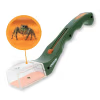
If you’re not too squeamish, you can use this gadget to catch a live spider and release it back outdoors. The device has a long handle, so you don’t have to get too close to the spider. You can also operate it with one hand — just move the device close to the spider, pull the trigger and scoop it up. Once caught, you (or your kids) can look at the spider under the built-in magnifying glass before sending it back outside.
Related

Want more from NBC Select? Sign up for our newsletter, The Selection, and shop smarter.
How I picked the best spider traps
If you are trying to evict spiders out of your home, you can always call an exterminator to help. In the event you want to try it on your own first (which will save you a lot of money), there are a few factors you should keep in mind when shopping for the best spider traps and eliminators, according to our pest control experts Hale and Hodges.
- Product type: There are a number of different types of products that can help you get rid of spiders, including sprays and traps. What you choose should be based on the type of spider problem you have. For example, if you tend to spot a lot of spiders in one specific area, placing a glue trap there may help. If you just randomly see one-off spiders every once in a while, a spray that kills on contact may make the most sense. To serve all needs, I included a variety of different product types on the list above.
- Disposal method: It’s one thing to eliminate a spider, it’s another thing to get rid of said spider. Spider traps and solutions will require that you throw out the spider after catching it, so you should think about what you can stomach. With a spray, you’ll need to pick that spider up to throw it out. With a glue trap, spiders will collect and be stuck and you’ll need to collect the traps to toss them once they’re full.
- Price: “I really want to spend a bunch of money on spider traps,” said nobody ever. Since this unsexy item is not something anyone wants to blow their budget on, I sourced spider traps and sprays that are all less than $20.
What causes a spider problem?
“Like other pests, spiders typically enter the home to seek food, water and shelter,” says Hodges. “If you are dealing with a pest they prey on, such as ants, roaches or another bug, that can attract more spiders to your home.”
Time of year and weather may also play a role in when you see more spiders. “While spiders are most active in the spring and summer, you’re more likely to encounter them in your home in the fall and winter as they seek shelter from the cold,” says Hodges. It is also possible that something you brought into your home carried spiders with it — like a plant or firewood from an outdoor wood shelter.
What else can you do to get rid of spiders?
Beyond traps and sprays, there are a few things you can do to prevent spiders from coming into your space — or to get rid of them if they do. First and foremost, keep a tidy home. “Frequent dusting, vacuuming, sweeping, and cleaning, under and around all objects is the best preventative move you can make,” says Hale. “It removes spiders and egg sacs, and the potential food that the spiders need.”
The other thing you can do is make sure you don’t have an issue with other insects. “Spiders feed on insects; if they are attracted to your home, it means they’re finding something to eat,” says Hodges. “Identify and address any other pests, like roaches or ants, to deter spiders.”
Meet our experts
At NBC Select, we work with experts with specialized knowledge and authority based on relevant training and/or experience. We also ensure all expert advice and recommendations are made independently and without undisclosed financial conflicts of interest.
- Walker Hale is an entomologist at Pest Share, a platform for finding pest control professionals.
- Scot Hodges is an entomologist and vice president of professional development and technical services at Arrow Exterminators.
Why trust NBC Select?
I am a commerce editor at NBC Select and a journalist who regularly covers home, organization,lifestyle and more. I have written about the best mouse traps, walking shoes, FSA-eligible items and more. For this story, I spoke with two pest control experts about how to get rid of spiders.
Catch up on NBC Select’s in-depth coverage of tech and tools, wellness and more, and follow us on Facebook, Instagram, Twitter and TikTok to stay up to date.


